




This is a preview of updates coming to the Technical Bulletin's website in April 2026. Return to current site.
Read more about the modernization release schedule in this announcement.
Comment via the yellow feedback button in the lower right hand corner of the page. Contact the NLM Help Desk with any questions or concerns.
This is archived content.
Links may have become inactive over time. Visit Archive-It to find the original published layout.
PubMed Central® IDs Display in PubMed® AbstractPlus Format
PubMed Central IDs Display in PubMed® AbstractPlus Format. NLM Tech Bull. 2008 Mar-Apr;(361):e6.
March 14, 2008 [posted]
March 31, 2008
[Editor's note added]
May 02, 2008
[Editor's note added]
August 13, 2008
[Sentence added]
[Editor's note: As of May 1, 2008, the PubMed Central ID, recently introduced on the MEDLINE and AbstractPlus formats in PubMed, now displays on the Citation and Abstract formats.]
As mentioned in the article, Skill Kit: NIH Manuscript Submission System - Get the Help You Need. NLM Tech Bull. 2008 Jan-Feb;(360):e6, the NIH Public Access Policy has become mandatory, requiring NIH grantees to submit a copy of their accepted, peer-reviewed article to PubMed Central (PMC). This requirement, and others, are explained at the NIH Public Access Policy Web site. An additional requirement is that researchers must provide the PMCID for articles when citing an article in grant applications, proposals, and progress reports. Details on this requirement are found within the Public Access Frequently Asked Questions.
Authors who need the PMC IDs (PMCID) of their publications to fulfill NIH Public Access Policy requirements can now find this on the PubMed AbstractPlus format. The PMCID appears to the right of the PMID in a slightly smaller, lighter-colored text. If there is an embargo date associated with the availability of the published article in PMC, that date is noted (see Figure 1).
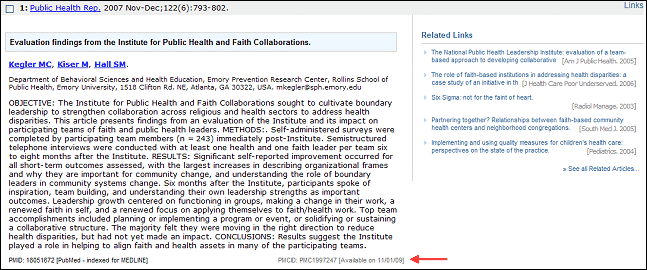
In the near future, the PMCID will also appear on the MEDLINE format with the field tag, PMC. Another new field for only the MEDLINE display is Manuscript ID which has the field tag, MID. [Editor's note: As of March 26, 2008 the PubMed Central ID and the Manuscript ID display in the MEDLINE format.]
- Example:
- PMC - PMC1463022
- MID - NIHMS3373
These fields do not appear on the XML display.
A Manuscript ID is an identifier assigned to an author manuscript submitted to the NIH Manuscript Submission System. This may be in support of the NIH Public Access Policy, or another funding agency's policy (e.g., Howard Hughes Medical Institute, Wellcome Trust).
PMCIDs and MIDs can be searched in PubMed as shown in these examples:
- pmc1463022
- nihms3373
PMCIDs can be searched in PMC in either of two ways:
- pmc1234567
- 1234567
MIDs can only be searched in PMC using the full identifier, e.g., HHMIMS35653.
[This sentence added on August 13, 2008.]
The PMID : PMCID Converter (//www.ncbi.nlm.nih.gov/sites/pmctopmid) translates PMIDs to PMCIDs and vice versa.