




This is a preview of updates coming to the Technical Bulletin's website in April 2026. Return to current site.
Read more about the modernization release schedule in this announcement.
Comment via the yellow feedback button in the lower right hand corner of the page. Contact the NLM Help Desk with any questions or concerns.
This is archived content.
Links may have become inactive over time. Visit Archive-It to find the original published layout.
Structured Abstracts: A New Look for the PubMed® Abstract Display
Ripple AM, Mork JG, Knecht LS. Structured Abstracts: A New Look for the PubMed® Abstract Display. NLM Tech Bull. 2010 Jul-Aug;(375):e11.
August 06, 2010 [posted]
August 16, 2010
[Editor's note added]
[Editor’s Note added August 16, 2010: These changes were implemented in PubMed on August 16, 2010.]
Nearly a quarter of all abstracts currently added to MEDLINE® include section labels such as BACKGROUND, OBJECTIVE, METHODS, RESULTS, and CONCLUSIONS. These abstracts, known as structured abstracts, will soon be reformatted for easier readability. Section labels will remain in uppercase followed by a colon, but will be bolded and each section will begin on a new line (see Figure 1).
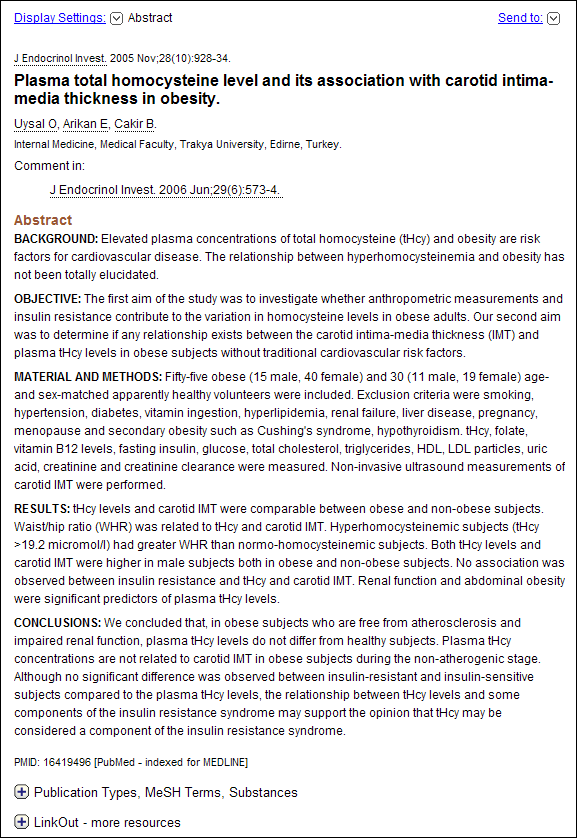
This change affects only the PubMed Abstract display using your Internet browser; it will not be available with other display formats, e.g., Abstract (text), and it will not be available using E-Utilities. There is no change for searching at this time.
The NLM® working definition of a structured abstract requires three or more unique section labels of which one must be considered an ending label representing the concept of "results" or "conclusions." Not every uppercase string followed by a colon in an abstract qualifies as a structured abstract label, e.g., DNA:. Hence, all newly-identified uppercase strings followed by a colon will be examined to determine if they qualify as structured abstract labels. This is also necessary as authors and editors continue to create new labels.
NLM is making preparations for PubMed structured abstracts to be segmented as part of our Year-End Processing data dissemination so that licensees of our data can also manipulate the display and searching of structured abstracts. Details are forthcoming.